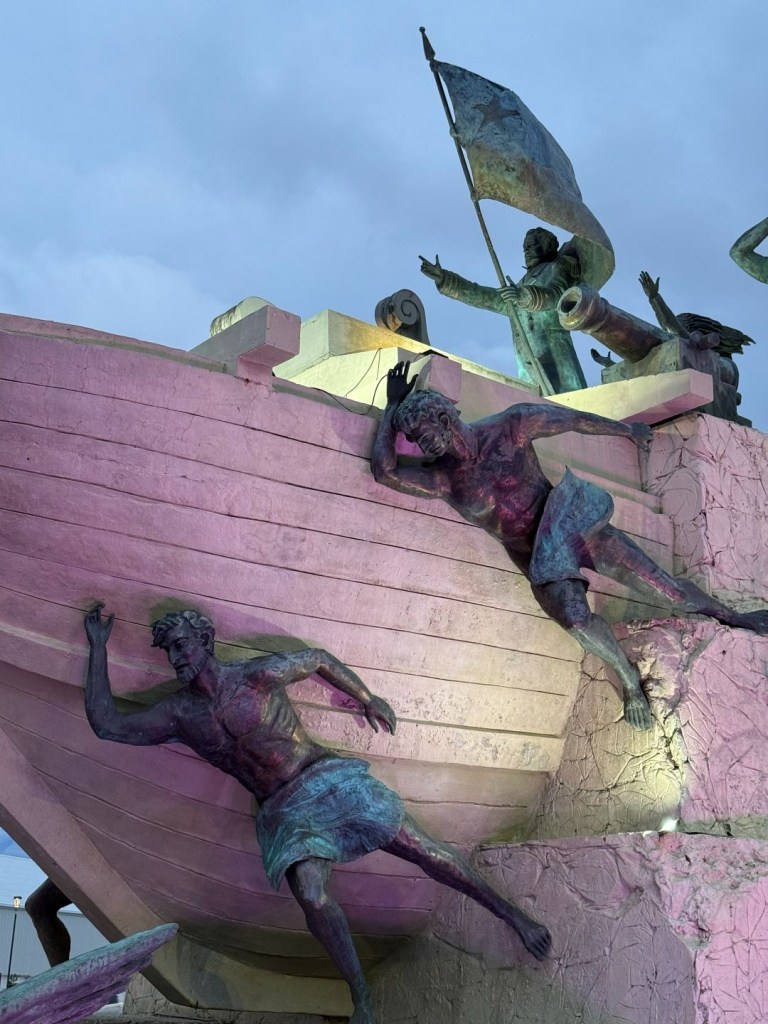
Sunday, December 7th – Arrival
Throughout the day, all WEBN Magallanes Seminar fellows gathered at the Diego Almagro Hotel in Punta Arenas, located right across from the shoreline of the Strait of Magellan. On the promenade between the hotel and the water stands a striking monument: a concrete ship with a long, slender cannon extending forward as if emerging from the sea. Sailors populate its upper deck, while mermaids adorn its lower sides, announcing its arrival. This mythological–historical assemblage is the Monumento a los Tripulantes de la Goleta Ancud, built in honor of the schooner Ancud, sent by Chile in 1843 to claim sovereignty over the Strait of Magellan and establish Fuerte Bulnes, where our seminar would begin the following day.
Day 1. Monday, December 8th, 2025 – Two Perspectives on Punta Arenas
After breakfast at the hotel, we boarded the bus and met our driver, Moises Contreras Pino, whose bus would accompany us on the journey in the coming days, and the videographer Nicolás Fernández—who would follow us daily during the seminars, capturing with his camera the best and worst moments of this adventure. In the minibus, we also met Paula Maynard, who helped translate from English to Spanish and vice versa, and she introduced us to local events and monuments from a touristic perspective. During the hour-long drive south to Fuerte Bulnes, we caught our first glimpse of the Magallanes landscape: small ranches, characteristic flora, and quiet waters. After stepping off the bus, we entered a complex of wooden structures—a reconstruction of the 1843 military garrison considered the first Chilean settlement on the Strait of Magellan. Fuerte Bulnes, named after its founder, President Manuel Bulnes, was relocated five years later 80 kilometers away to the south and named the new settlement Punta Arenas.
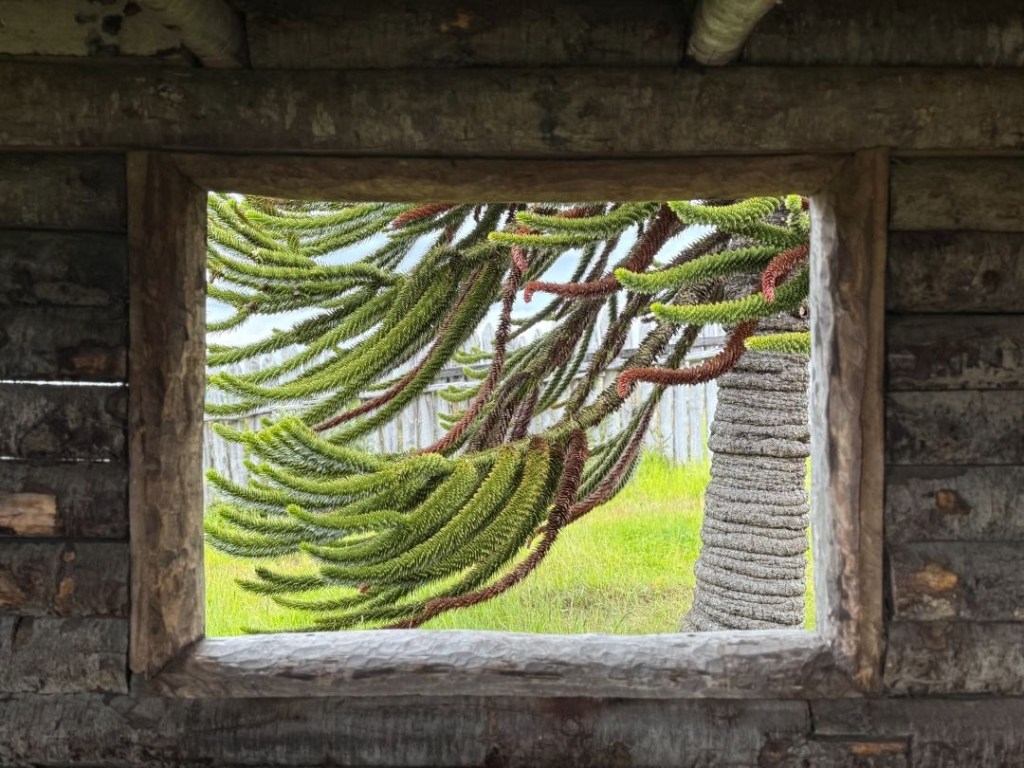
A short walk through the grove surrounding the garrison brought us to the shore. Nearly every tree was swollen with the bright orange, puffed Cyttaria hariotii fungus, a common edible species in Andean Patagonia. After blocking the sap of its host, it grows on the branches as if it were the tree’s fruit.
Our next stop was at the Museo del Estrecho, overlooking Puerto del Hambre (“Port of Famine”), the site of a failed Spanish settlement attempt in the late sixteenth century. Due to extreme weather conditions, the 300 settlers of Ciudad Rey Don Felipe starved or froze to death. This episode—responsible for the settlement’s grim name—is seamlessly woven into the Chilean national ethos surrounding Fuerte Bulnes. As one inscription in the museum reads: “What the rich and powerful Spanish Empire could not accomplish, the young and modest Chilean Republic managed to achieve.”

Back in Punta Arenas, we unexpectedly came across the city’s Bomberos Day celebrations. Fire engines—each representing a different European immigrant community—and many groups of firefighters, kids, families and young couples filled the streets around the main square. Punta Arenas has its roots in the population of European colonists (Croatian and Spanish) who settled the area in the mid-nineteenth century. There are also descendants of people from other countries (i.e., German, English, Italian, Swiss, and others).
After lunch at Tapiz restaurant, WEBN fellow Ariel Florencia Richards guided us through three sites connected to the early life of Punta Arenas–born artist Lorenza Böttner: her former schoolyard (now a parking lot); the electricity pole she climbed while trying to retrieve a bird’s egg as a gift for her teacher—an accident that led to her electrocution herself and the subsequent amputation of both arms; and finally, her family home in a suburban neighborhood of the city.

Through Ariel’s delicate act of storytelling, we were guided both into and beyond this constitutive accident, imagining Lorenza’s childhood around the event while expanding its field of meaning embracing known facts alongside gaps, speculation, and uncertainty.
The walk ended at a viewpoint overlooking the city and shoreline. After a brief break, we gathered again at the production house of Cielos del Infinito, the world’s southernmost arts festival. There, Andrea Pereda Negroni described the festival’s activities since its founding in 2008, which have been held in Puerto Williams, Porvenir, Puerto Edén, Puerto Natales, San Gregorio, Cerro Castillo, Cerro Sombrero, and Punta Arenas.
The day ended with pisco sours and dinner at La Marmita.