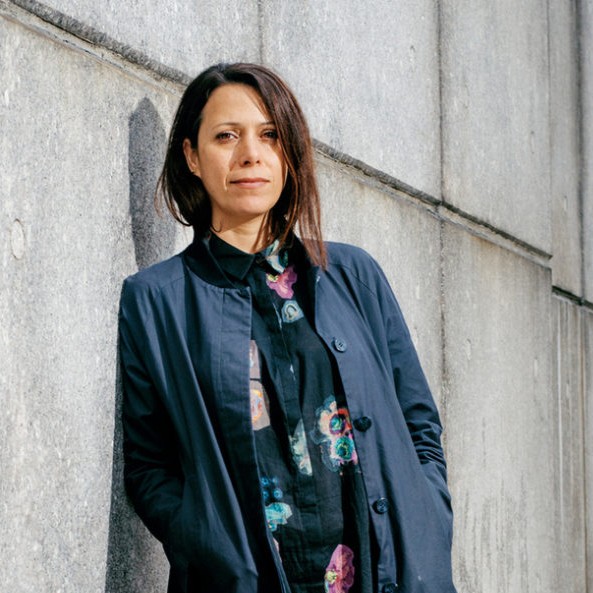
Malkit Shoshan is a designer, researcher, educator, writer, and the founding director of the architectural think-tank FAST: Foundation for Achieving Seamless Territory. FAST employs research, advocacy, design, and public art to explore and make visible the relationships between architecture, urban planning, and human rights. The foundation’s interdisciplinary work aims to promote social and environmental justice through collaborative initiatives and designs. Malkit teaches as a design critic at Harvard University Graduate School of Design, where she is also the former director of the Master’s in Design Studies in Art, Design, and the Public Domain.
Malkit is the author and mapmaker of the award-winning book “Atlas of Conflict: Israel-Palestine” (Uitgeverij 010, 2010), and the co-author of “Village. One Land Two Systems and Platform Paradise” (Damiani Editore, 2014), a book that narrates the story of an internally displaced community in Israel and showcases Shoshan’s participatory design process to develop an alternative masterplan for the village, advocating for spatial equality and state services. Her other publications include “ZOO” (NAiM, 2012), “Drone. UNMANNED. Architecture and Security Series” (DPR-Barcelona, 2016), “Retreat. UNMANNED. Architecture and Security Series” (DPR-Barcelona, 2020), “Spaces of Conflict” issue for Footprint, TU Delft Architecture Theory Journal (JAP SAM Books, 2017), “Greening Peacekeeping: The Environmental Impact of UN Peace Operations” (The International Peace Institute, 2018), and “UN Peace Missions in Urban Environments and the Legacy of UNMIL” (FAST, CIC-NYU, 2019).
In 2021, Malkit, alongside FAST, was awarded the Silver Lion at the Venice Architecture Biennale for their collaborative project titled “Border Ecologies and the Gaza Strip: Watermelon, Sardines, Crabs, Sand, and Sediment.”
She curated the Dutch Pavilion at the Venice Architecture Biennale in 2016, presenting the exhibition “BLUE: Architecture of UN Peacekeeping Missions.” This exhibition was part of FAST’s long-term research and design project that examines the impacts of UN missions on cities, communities, and the environment, leading to the development of policy recommendations, policy papers and influencing a UN resolution in 2017. The project is also the focus of her recent book, “BLUE: The Architecture of UN Peacekeeping Missions“(Actar, 2023).